
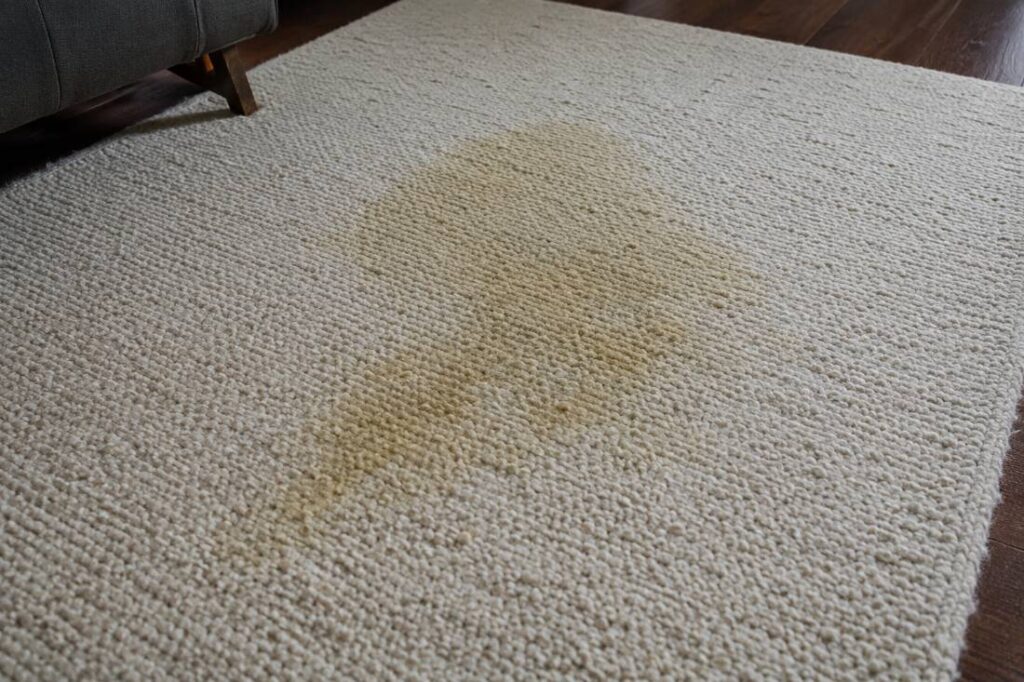
You tried the enzyme spray. Maybe a rental machine. The smell came back within a week.
Pet urine in an area rug is one of the more stubborn problems a homeowner can face. The odor returns because the source of it was never fully removed. Home cleaning tools and store-bought products are not built to reach it.
Understanding why home methods fall short makes the case for a different approach — one that starts with taking the rug out of your home entirely.
The Problem With Pet Urine Goes Deeper Than the Surface
When a pet urinates on a rug, the liquid moves fast. It passes through the pile and reaches the backing within seconds. From there it soaks into any padding beneath the rug and, depending on how long it sits, into the floor underneath.
What dries on the surface is not just moisture. Urine leaves behind uric acid crystals, bacteria, and concentrated salts. These bind to rug fibers at a microscopic level. They do not evaporate. They do not break down on their own.
Heat makes things worse. A warm room, sunlight through a window, or humidity from a coastal summer can reactivate those crystals. That is why a rug can smell fine in January and become unbearable in July.
Why Store-Bought Products Only Go So Far
Enzyme-based sprays are the most common recommendation for pet urine odor. They work by introducing bacteria that break down urine compounds — in theory. In practice, several things limit their effectiveness on area rugs.
They Cannot Penetrate Deep Enough – A spray applied to the surface of a rug may reach the top layer of fibers. It will not fully saturate the backing or reach contamination that has migrated deep into the rug structure. The odor source stays in place.
The Dwell Time Is Rarely Long Enough – Enzyme products need sustained contact with urine residue to break it down. In a home setting, the rug continues to dry while the product is working. Dry conditions reduce the enzymes’ effectiveness significantly.
Rinsing Is Not Possible Without the Right Equipment – Removing broken-down contamination requires flushing it out of the rug with clean water under pressure. That step is not possible with a spray bottle or a portable carpet machine. The residue stays in the rug after treatment.
Rental Machines Are Not Designed for Rugs – Portable extractors and home carpet machines are built for wall-to-wall carpet. They do not produce the water pressure or suction needed to flush and extract contamination from the dense construction of most area rugs. Wool, Persian, and Oriental rugs are especially difficult to treat this way without risking damage to the fibers.
What In-Plant Cleaning Does Differently
GM Carpet Care operates an in-plant rug cleaning facility in Toms River. The facility is built specifically for area rugs — not adapted from carpet cleaning equipment, but purpose-designed for the different demands of rug fiber, backing, and construction.
The process starts before the rug is touched. Each rug is inspected to assess fiber type, backing material, construction, and the extent of contamination. That assessment determines the cleaning approach. A wool rug with natural dyes requires different treatment than a synthetic rug with a latex backing.
Pre-Treatment That Reaches the Source
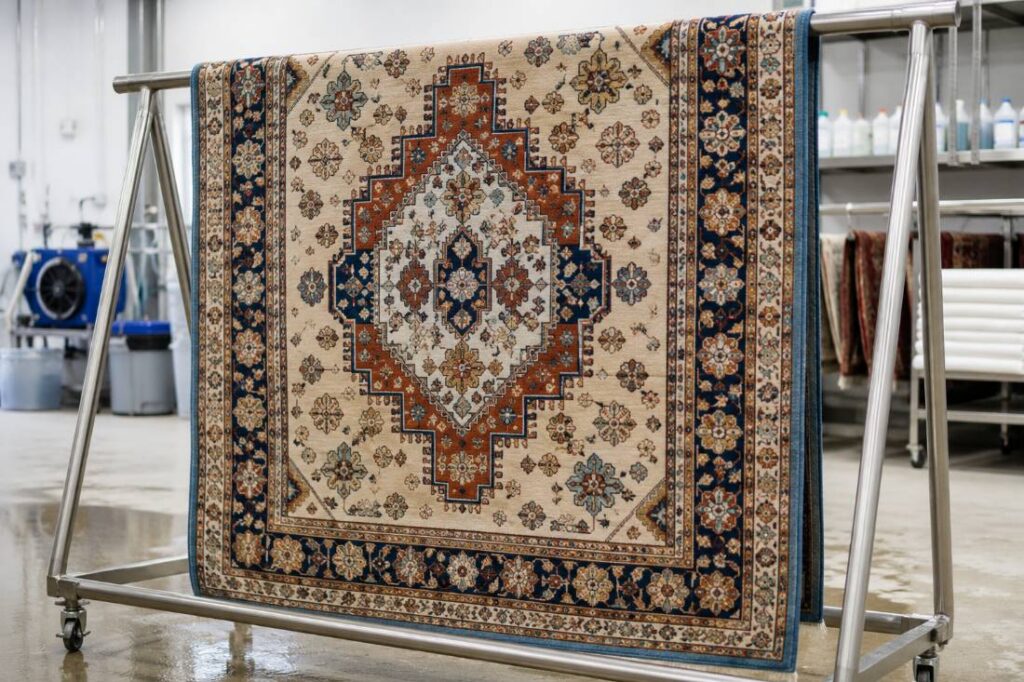
A professional-grade urine pre-treatment is applied to fully saturate the rug — not just the surface. The solution is formulated to penetrate backing materials and begin breaking down uric acid crystals before any washing begins.
Dwell time is controlled in the facility. The rug is not drying out during treatment the way it would in a living room.
Full Submersion Washing
The rug is washed with enough water volume to actually flush contamination out of the fibers. This is not surface extraction. The rug receives the kind of thorough rinse that removes what the pre-treatment has loosened.
For heavily contaminated rugs, this process may be repeated. GM Carpet Care has restored rugs that had been professionally cleaned elsewhere multiple times and still carried strong odor — because prior treatments had not included the flushing step.
Controlled Drying
How a rug dries affects both the result and the rug’s condition. Drying too slowly can allow mildew to develop. Drying with too much heat can damage wool or cause colors to bleed. In-plant drying is managed to protect the rug while removing moisture efficiently.
Pickup and Delivery Makes the Process Simple
GM Carpet Care picks up rugs directly from your home and returns them when the cleaning is complete. You do not need to transport the rug yourself or arrange drop-off at a facility.
This matters with pet urine situations because handling a heavily contaminated rug in a car or truck is an unpleasant process most homeowners would rather avoid. The pickup and delivery service handles that for you.
Once the rug is returned, it comes back clean, dry, and free of the odor that sent it out.
When to Call Instead of Trying Again
If you have already treated a rug for pet urine once and the smell returned, a second home treatment is unlikely to produce a different result. The contamination that survived the first attempt will survive the second.
Rugs that have experienced repeated accidents over time build up layers of contamination that surface cleaning cannot address. The longer that buildup sits, the harder it becomes to reverse.
There is a point where the cost of continued home treatments — in product, rental equipment, and time — exceeds the cost of professional in-plant cleaning. For rugs with real value, either financial or personal, professional treatment is the more reliable path.
Serving Homeowners Across Ocean, Monmouth, and Cape May Counties
GM Carpet Care provides area rug pickup, in-plant cleaning, and delivery service throughout Ocean County, Monmouth County, and Cape May County. Our IICRC certified technicians have handled pet urine contamination in every type of area rug, from machine-made synthetics to hand-knotted wool rugs that have been in families for generations.
If your rug still smells after home treatment, the in-plant process is the next step worth taking. Contact GM Carpet Care at 732-929-9669 or visit our area rug cleaning page to schedule pickup.
Call 732-929-9669 or Contact Us for Area Rug Cleaning

Mark Case is the owner of GM Carpet Care, a family-owned cleaning company serving Ocean and Monmouth County homeowners since 1978. He and his team hold IICRC certification — the industry’s highest professional standard — and have built a reputation across the Jersey Shore for honest, reliable service. Mark oversees every aspect of the business, from area rug cleaning at the Toms River facility to carpet repair and water damage response.